5 Powerful Mantras to Raise Your Vibration — Meanings, Frequencies & How to Practice
From Om Ucharan to So Hum — sacred chants with pronunciation guides, Hz frequencies, and step-by-step practice rituals
“Sound is not just heard — it is felt. Mantras are frequencies that the body remembers.”
In a world where energy and vibrations shape our experiences, the ancient science of mantra chanting offers a direct pathway to raise your vibration and elevate your state of being. These mantras to raise your vibration were not composed — they were discovered, encoded into sound by rishis who perceived the vibrational fabric of reality itself.
Whether you’re a seasoned yoga practitioner or just stepping onto the path, this guide gives you not just the mantras, but their hidden meanings, sound frequencies, pronunciation guides, and step-by-step practice rituals so you can actually feel the shift.

Om Ucharan — The Best Mantra to Raise Your Vibration
ॐ (Om / Aum)
The Primordial Sound of the Universe
🎵 136.1 Hz — Earth Frequency🕐 Best time: Brahma Muhurta (4–6 AM)♾ Repetitions: 108 times
Om (also written as Aum) is not just a syllable — it is the fundamental vibrational sound of the cosmos. Modern science has measured the Earth’s natural resonant frequency at approximately 136.1 Hz, which corresponds to the pitch at which Om is traditionally chanted. This is not coincidence; it is alignment.
Om Ucharan (Om chanting practice) is the disciplined act of vocalizing Om with full awareness. It differs from casually saying “om” — Ucharan implies precise sound production from the navel, rising through the chest, resonating in the throat, and dissolving into silence at the crown.
The syllable is composed of three sounds: A (creation, waking state), U (preservation, dream state), and M (dissolution, deep sleep) — followed by silence, representing the transcendent. Chanting all four phases aligns you with the full cycle of existence.
🗣 Pronunciation Guide“Ahhh” (from belly) → “Ooooh” (chest) → “Mmmmm” (lips sealed, skull vibrates) → Silence (5–10 seconds)

Benefits backed by research: Studies from institutions including the All India Institute of Medical Sciences (AIIMS) have found that Om chanting reduces activity in the limbic system — the brain’s stress center — while activating the vagus nerve, which governs the parasympathetic (rest and restore) nervous system.
So Hum — The Breath Mantra
सो ऽहम् (So Hum) mantra meditation — I am that — mantra to raise vibration and self-awareness
“I Am That” — Union with the Universe
🎵 Natural breath frequency🕐 Best time: Any meditation🔄 Synchronized with breath
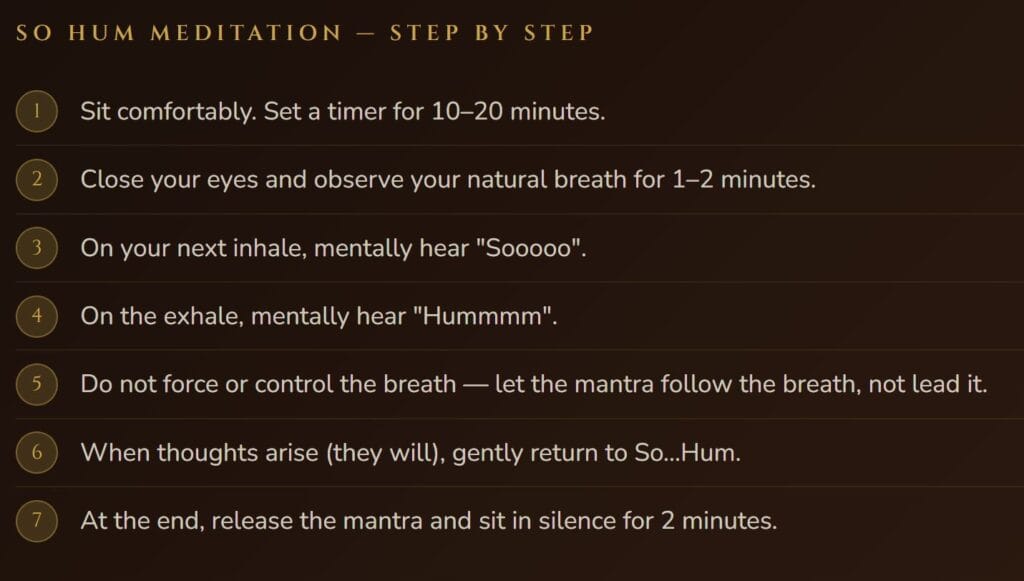
“So Hum” is considered the most natural mantra in existence — because you are already chanting it. The sound of your inhale is “So” and the sound of your exhale is “Hum.” Every living being, without exception, chants this mantra approximately 21,600 times per day.
In Sanskrit, So = “that” (the universe, the divine, consciousness itself) and Hum = “I am.” Together: “I am that infinite consciousness.” This is the essence of Advaita Vedanta — the non-dual understanding that you are not separate from the universe but an expression of it.
Pronunciation GuideInhale:
Inhale: “Soooo” (soft S, long O sound, like a distant wind)
Exhale: “Hummmm” (the H is nearly silent; emphasis on nasal “umm”)
Lokah Samastah Sukhino Bhavantu
लोकाः समस्ताः सुखिनो भवन्तु
“May All Beings Everywhere Be Happy and Free”
Opens: Heart Chakra (Anahata) 🕐 Best time: Close of practice or morning
♾ Repetitions: 3 or 7 times
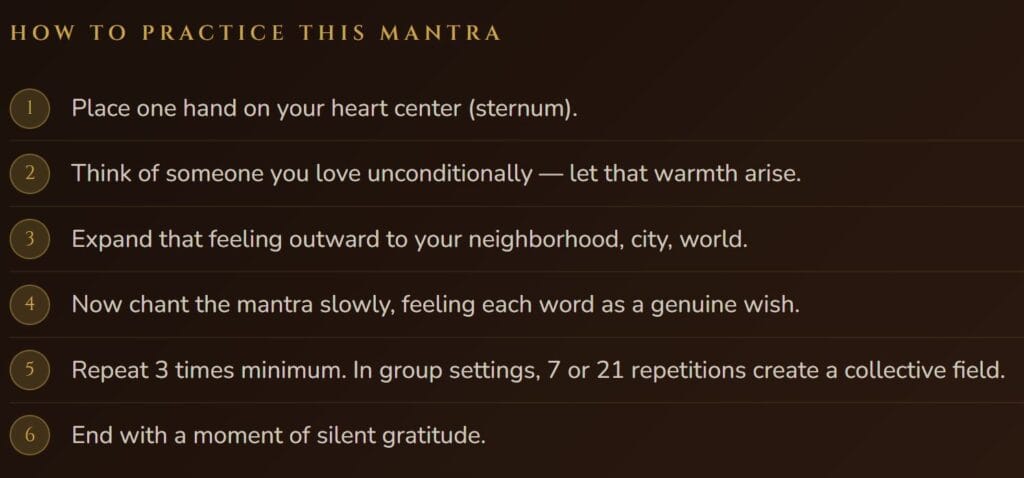
This is perhaps the most expansive mantra in the yoga tradition. The full meaning: Lokah = all realms/beings; Samastah = all, completely; Sukhino = happiness, ease; Bhavantu = may there be, let it be so. It is a blessing sent to all beings without exception — including yourself.
What makes this mantra uniquely powerful for vibration elevation is that it activates loving-kindness (Metta in Buddhist tradition). Neuroscientific research on compassion practices shows that generating feelings of unconditional goodwill measurably increases the brain’s production of oxytocin and serotonin — the very molecules of elevated emotional states.
Pronunciation Guide :
LO-kaah · sa-MAS-taah · su-KHI-no · bha-VAN-tu
(The ‘kh’ in Sukhino is a soft aspirated K, not harsh)
Om Shanti Shanti Shanti
Om Shanti mantra — peace chant at 432 Hz to raise vibration and reduce stress
ॐ शान्तिः शान्तिः शान्तिः
“Peace in Body, Mind and Spirit”
🕊 Dissolves: Stress & Anxiety 🕐 Best time: Evening / before sleep
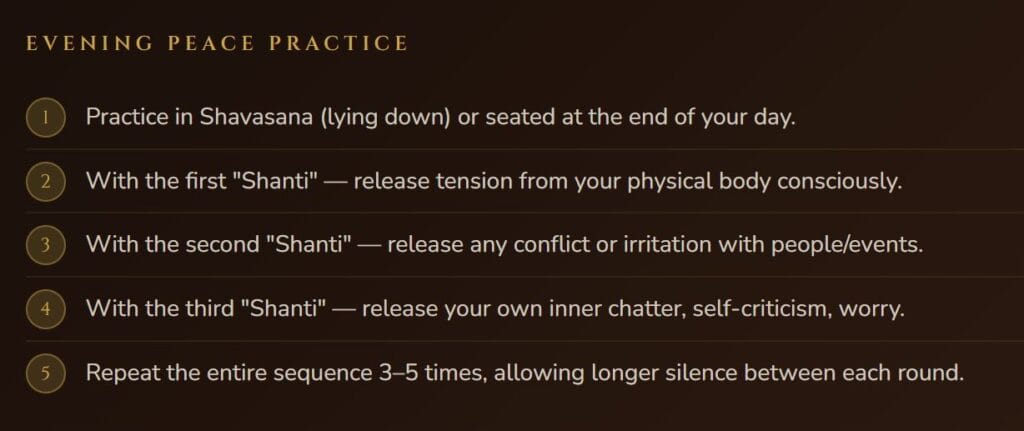
🔢 The 3 Shantis represent: 3 planes of existence
Most practitioners know “Om Shanti” as a simple peace chant — but the triple repetition of Shanti carries deep cosmological significance. The three Shantis address peace across the three types of suffering described in Vedic philosophy: Adhidaivika (cosmic/natural forces), Adhibhautika (external world, other beings), and Adhyatmika (internal, self-created suffering).
Chanting Shanti three times is therefore a complete prayer — you are simultaneously releasing resistance to life’s uncontrollable forces, releasing resentment toward others, and releasing internal self-conflict.
Pronunciation Guide
Om (long) · SHAAN-tih · SHAAN-tih · SHAAN-tih
(The ‘sh’ is like the English “sh”; ‘t’ is soft dental, not retroflex)
Om Gam Ganapataye Namaha
Om Gam Ganapataye Namaha — Ganesha mantra to remove obstacles and raise vibration
ॐ गं गणपतये नमः
“Salutations to Ganesha, Remover of Obstacles”
🐘 Deity: Ganesha (Ganapati) 🕐 Best time: New beginnings, mornings
♾ Repetitions: 108 times
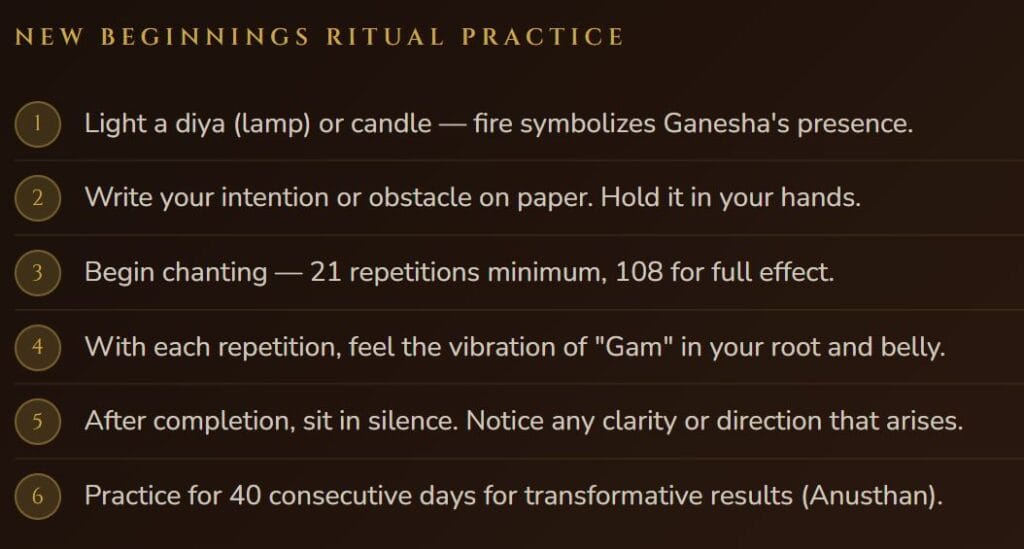
Lord Ganesha is the deity of beginnings, intelligence, and the remover of obstacles. The bija (seed) mantra Gam (sometimes written “Gum”) is the concentrated vibrational essence of Ganesha — a single syllable that carries the entire energetic signature of this deity. Chanting it activates the root and sacral chakras, grounding you while simultaneously opening creative channels.
This mantra is especially powerful when you are starting a new project, facing a significant life challenge, or feeling creatively blocked. It does not remove difficulty through magic — it removes the internal resistance to moving forward, which is often the real obstacle.
Pronunciation Guide
Om (long) · Gum (short, hard G) · Guh-nuh-PUH-tuh-yay · Nuh-MAH-ha
(The final ‘ha’ is a gentle exhale, not hard H)
At a Glance
All five mantras compared
| Mantra | Core Meaning | Best For | Frequency / Hz | Reps |
|---|---|---|---|---|
| Om (Ucharan) | Universal sound, unity | Grounding, healing, stillness | 136.1 Hz | 11 / 108 |
| So Hum | I am the universe | Deep meditation, identity | Breath-linked (~0.2 Hz) | Continuous |
| Lokah Samastah | May all beings be free | Compassion, heart opening | 528 Hz (love frequency) | 3 / 7 / 21 |
| Om Shanti | Peace in all dimensions | Stress release, evening calm | 432 Hz | 3–9 |
| Om Gam Ganapataye | Salutations to Ganesha | New beginnings, obstacles | Root chakra (256 Hz) | 21 / 108 |
ऑरा बढ़ाने के मंत्र (Aura Badhane ke Mantra)
ॐ · सो ऽहम् · ॐ शान्तिः · ॐ गं गणपतये नमः
इन पाँच मंत्रों का नियमित जप आपकी ऊर्जा को शुद्ध करता है और आभामंडल (aura) को शक्तिशाली बनाता है। प्रतिदिन ब्रह्म मुहूर्त में (सुबह 4 से 6 बजे) इन मंत्रों का उच्चारण करने से मन की शांति, एकाग्रता और आत्मविश्वास बढ़ता है।
Translation: Regular chanting of these five mantras purifies your energy and strengthens the aura. Practicing during Brahma Muhurta (4–6 AM) daily increases mental peace, concentration and self-confidence.
How many times should I chant a mantra to feel its effects?
The traditional number is 108 repetitions — considered sacred in Vedic numerology (1 represents the divine, 0 represents emptiness/completeness, 8 represents infinity). For beginners, 11 or 21 repetitions daily for 40 consecutive days (an Anusthan) is an excellent starting practice. Consistency matters more than count: 11 daily is more powerful than 108 once a week.
What is the best mantra to raise vibration quickly?
Om Ucharan produces the fastest measurable physiological shift — studies show that a single 10-minute session reduces cortisol and activates the parasympathetic nervous system. For emotional elevation specifically, Lokah Samastah is particularly effective because it generates compassion — one of the highest-frequency emotions.
Can I chant mantras without knowing Sanskrit?
Yes — and this is an important point. The power of mantras is vibrational, not semantic. The sound matters more than intellectual understanding. However, knowing the meaning deepens your intention, which amplifies effectiveness. Use the pronunciation guides in this post, listen to authentic recordings, and don’t be discouraged by imperfection. Sincerity of practice matters most.
What is the difference between Om and 432 Hz / 136.1 Hz?
136.1 Hz is the resonant frequency of Earth’s orbit around the Sun (calculated by slowing Earth’s year down to the audible range) — this corresponds to the traditional Om pitch used in Indian classical music. 432 Hz is an alternative concert tuning (vs the standard 440 Hz) considered more harmonically aligned with nature. 528 Hz is associated with the “love frequency.” These are different measurements; Om at 136.1 Hz is the most historically documented.
What is Om Ucharan and how is it different from chanting Om?
Ucharan (उच्चारण) means “pronunciation” or “articulation” in Sanskrit. Om Ucharan refers to the disciplined, conscious practice of vocalizing Om with precise technique — drawing from the navel, through the chest, resonating the skull, and dissolving into silence. Casually saying “om” at the start of a class is different from Om Ucharan as a dedicated practice.
Are Grabovoi codes related to mantra vibration?
Grabovoi codes are numerical sequences developed by Grigori Grabovoi, claimed to carry specific vibrational frequencies for healing or manifestation. While they come from a different tradition than Vedic mantras, both operate on the principle that focused intention combined with specific sound or number sequences can influence energy fields. Mantras are far more historically documented and tested; Grabovoi codes are a modern, controversial practice. If you are exploring both, they can be treated as complementary intention-setting tools.
Begin Your Practice Today
Even five minutes of daily Om Ucharan can shift your baseline energy within two weeks. Choose one mantra, commit to 21 days, and feel the difference.
These five mantras to raise your vibration are among the most powerful tools in the yoga tradition. Whether you are looking to deepen your meditation, elevate your emotional frequency, or simply find more calm in daily life, consistent mantra practice creates measurable, lasting change. Start with Om Ucharan for one week, then add So Hum to your morning routine.
Studies has show the immediate effect of OM Chanting on heart rate has good results and health benefits,
Continue your journey: 5 Lessons from Autobiography of a Yogi · More Yoga Guides →